
What Kids Can Learn From Soccer: Social Emotional Learning and Life Lessons From the World Cup
Updated: 6 days ago

I recently watched an interview with Jude Bellingham that really stuck with me. Instead of talking about goals or trophies, he talked about mental health, vulnerability, and the importance of having someone to talk to. It's a message I hope more young people hear. Watch the interview below where Jude shares why talking about mental health matters and why asking for help is a sign of strength. This post may contain affiliate links. I may earn a commission at no extra cost to you.
When my son started playing soccer, like so many other parents, I spent my weekends on the sidelines in a folding chair, with snacks packed, and coffee in hand. At first, I was there because he loved it but before long, I found myself learning the rules, celebrating every goal, and paying attention to the strategy behind the game. Somewhere along the way, I stopped being a soccer mom and became a genuine soccer fan. Now I look forward to the World Cup just as much as he does.
This year, I knew I was rooting for Cape Verde before the tournament even began. TBH, my reason had very little to do with soccer. It's because I spent the first sixteen years of my career working in schools where many of my students and their families were Cape Verdean. If you're not from Massachusetts, you may not realize that our state is home to one of the largest Cape Verdean communities in the United States. Cities like Brockton, New Bedford, and Boston have vibrant Cape Verdean communities that have shaped the culture of southeastern Massachusetts for generations (U.S. Census Bureau, 2020).

Some of my earliest memories as a school adjustment counselor involve Cape Verdean students and families. I learned about traditions, family values, food, music, and the incredible sense of pride people have in their heritage. Those relationships influenced the counselor I became, so watching Cape Verde walk onto the world's biggest soccer stage this year felt personal.
As I watched the tournament, I realized I wasn't only cheering for a team. I was thinking about former students who were probably watching with their parents and grandparents. I thought about families gathering together to celebrate every save, every goal, and every historic moment, and it also reminded me why I love sports so much.
As school counselors, teachers, and parents, we spend a lot of time intentionally teaching social-emotional learning. We plan classroom lessons about empathy, cooperation, emotional regulation, and problem solving because we know these skills help children succeed in school and in life. Plus, a large body of research has also shown that when students receive high-quality social emotional learning instruction, they demonstrate stronger social and emotional skills, healthier relationships, fewer behavior problems, and even improved academic achievement (Collaborative for Academic, Social, and Emotional Learning [CASEL], 2024; Taylor et al., 2017).

What we sometimes forget is that children are also learning these same skills outside the classroom or couneling office every day. Sports provide some of the richest opportunities for SEL because the lessons happen in real time. Children experience disappointment after missing a shot, they practice self-control when a ref makes a call they disagree with, they learn to cooperate with teammates, and they celebrate each other's successes and work through mistakes together. Research has found that participation in organized sports is associated with positive psychological and social outcomes including improved self-esteem, stronger social skills, and greater social connectedness (Eime et al., 2013).
But even children who never play organized sports can learn something by watching sports. Every match offers opportunities to talk about perseverance, teamwork, empathy, leadership, and emotional regulation in ways that feel authentic since they're happening in real time. In this blog post we will explore many important life lessons soccer can teach kids.

Life Lessons from Soccer: What Vozinha Can Teach Kids About Perseverance

One of the players who left the biggest impression on me this World Cup was Cape Verde's goalkeeper, Vozinha.
If you only looked at the highlights, you would see an outstanding performance against one of the tournament favorites. At forty years old, Vozinha made his FIFA World Cup debut and helped Cape Verde earn a historic draw against Spain. His seven saves also earned him Player of the Match honors (FIFA, 2026).
When I saw what a strong player Vozinha was, I started learning more about him and what really caught my attention was the fact that he didn't become a professional soccer player until he was twenty-five years old. Before soccer became his career, he worked as an electrician. While many athletes begin playing professionally as teens or young adults, his journey looked pretty different. He spent years continuing to train, improve, and believe in himself before finally reaching the biggest stage in international soccer (Confederation of African Football [CAF], 2026)!

So many children believe they have to be good at something right away. If they struggle with reading, math, making friends, or learning a new skill, they often assume they simply aren't "good at it" and want to give up right away. They compare themselves to peers who seem to learn faster and begin doubting themselves before they've had enough time to grow.
Vozinha's story reminds us that success rarely follows the same timeline for everyone. Growth can be slow, progress isn't always obvious, and some of the biggest accomplishments come after years of showing up and doing the work!
Research on growth mindset suggests that children are more likely to persevere through challenges when they believe their abilities can improve through effort and learning rather than being fixed traits (Dweck, 2006). While talent certainly matters, persistence, practice, and resilience play an enormous role in long-term success.
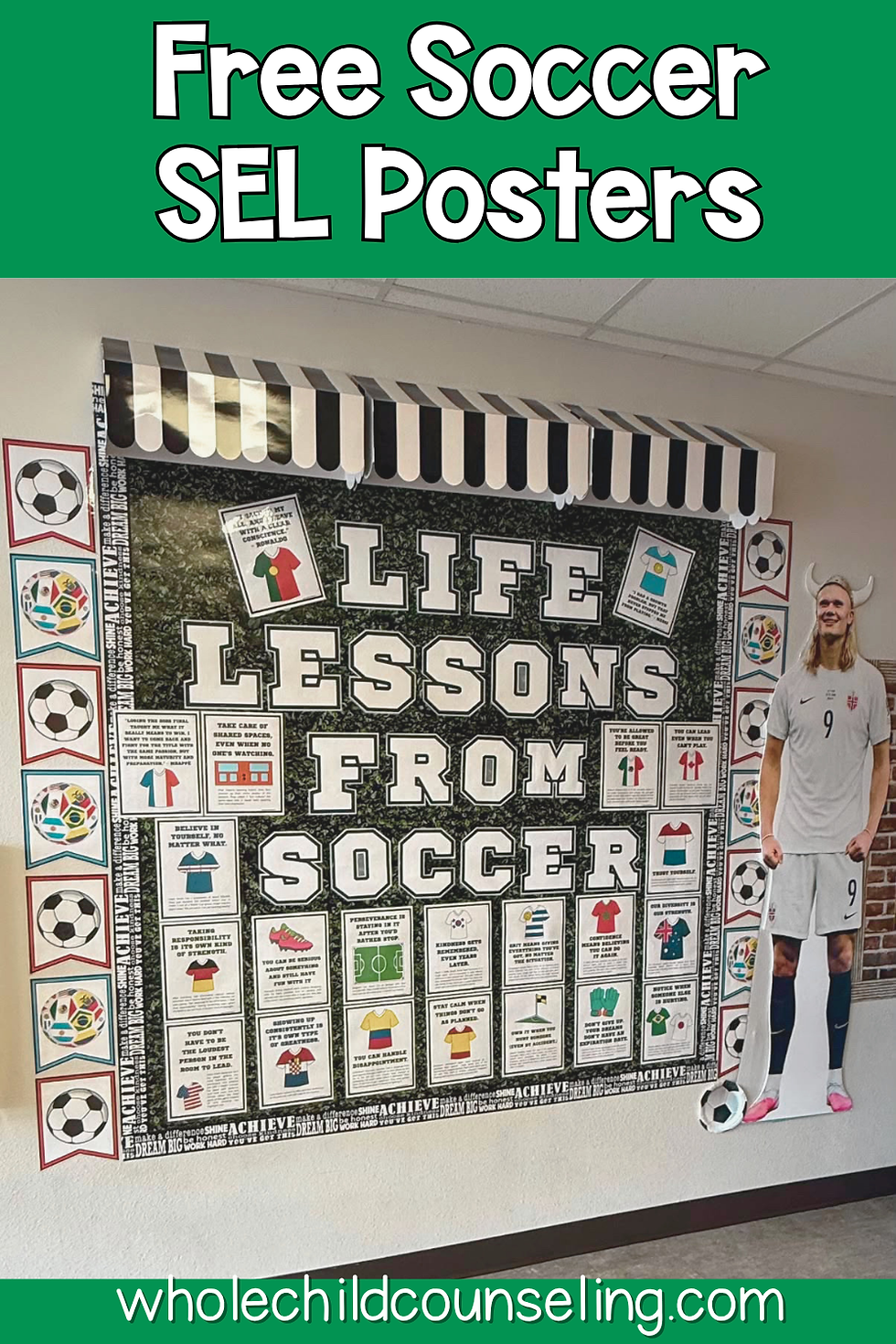
One of my favorite posters from my free Soccer SEL Bulletin Board Set captures this idea with a simple message:
"Don't give up. Your dreams don't have an expiration date."
The poster was inspired by Vozinha's journey because children deserve reminders that everyone follows a different timeline. If you want a copy of this free 25 poster set that also comes with bulletin board letters, sign up here to join my email list and access my free SEL resource library! I also send out FLASH freebies to subscribers and SEL tips and resources.

What Kids Learn When Athletes Show Their Emotions

There was another moment after the match that stayed with me too. During a postgame interview, Vozinha became emotional as he talked about his grandparents who raised him and his mother, who was not there to witness one of the biggest moments of his career due to Visa issue (FIFA, 2026).
As a school counselor, I couldn't stop thinking about what children were seeing. They were watching an elite athlete compete under pressure, who was also crying openly as he talked about the people who helped him get there!
For generations, many boys have received messages that being strong means hiding sadness, pushing down emotions, or pretending everything is fine. Research has found that these traditional expectations around masculinity can make it harder for boys to express emotions and seek support when they need it (Way, 2011).
This World Cup has shown children a different picture of strength! They've watched athletes comfort opponents after heartbreaking losses, celebrate teammates instead of chasing individual recognition, accept responsibility after mistakes, and express gratitude for the people who supported them along the way. Confidence, compassion, humility, and vulnerability can all exist together.

Real World Cup Moments That Teach Social Emotional Learning

The more matches I watched and the more we talked with my son, the more I found myself thinking, this would make a great conversation with students too!
One moment that stayed with me involved Iraq's Aymen Hussein. He made history by scoring Iraq's first World Cup goal in forty years, giving his country a reason to celebrate. Then, in a heartbreaking turn of events, he accidentally scored an own goal in stoppage time while trying to defend Norway's attack. Most of us have experienced moments when one mistake makes us forget everything we did well beforehand. That's why I created the poster, "A mistake doesn't get to write the whole story." Students need reminders that one difficult moment should never erase their effort, growth, or accomplishments!
Another poster grew out of watching England play most of a knockout match with only ten players after a red card. They couldn't change what happened, but they could control how they responded. Instead of falling apart, they stayed focused, adapted, and found a way to win. That became the message: "You can't control what happens, only how you respond." It's a lesson that applies just as much in the world as it does on the soccer field. Students can't control every grade, every disagreement, or every unexpected challenge, but they can learn healthy ways to respond to challenges.
Another touching moment of the tournament came after Brazil goalkeeper Alisson noticed how devastated Japan's Ao Tanaka was after his team's

heartbreaking elimination. Instead of celebrating his own team's success, Alisson stopped to put his arm around his opponent and offer comfort. That act of empathy inspired another poster: "Notice when someone else is hurting." Moments like these remind children that kindness is not reserved for teammates. We can show compassion even to people we're competing against.
CASEL describes social and emotional learning as the process of developing the knowledge, skills, and attitudes needed to understand emotions, build healthy relationships, make responsible decisions, and achieve goals (CASEL, 2024). And children learn social emotional skills best when they can connect them to real experiences.
That is exactly what sports can provide. Whether children are playing the game themselves or watching from the sidelines, they're seeing emotional regulation, empathy, teamwork, responsible decision making, and healthy relationships unfold in real time.

Free Soccer SEL Posters for Your Classroom

Those moments (and your requests on my instagram) inspired me to create this FREE Soccer Social Emotional Learning Bulletin Board and Poster Set. You can sign up for my email list to access the 25 free posters here. Each poster highlights a lesson inspired by real moments from the World Cup and connects them to skills children can use every day.
One of my favorites says, "Showing up consistently is its own type of greatness." Inspired by Luka Modrić, who played in his fifth and final World Cup at 40 years old after more than two decades representing Croatia. Most children notice the trophies and the highlight reels, but they don't always see the years of practice, discipline, and perseverance that come first. Whether students are learning to read, practicing an instrument, or developing a new skill, success usually comes from showing up consistently, even when progress feels slow.

Another poster reminds students that "Taking responsibility is its own kind of strength." After Germany was eliminated from the tournament, captain Joshua Kimmich didn't blame bad luck or the referees! Instead, he openly accepted responsibility for the team's performance. Owning our mistakes isn't always easy, but it helps children develop self-awareness and learn from setbacks instead of looking for someone else to blame. Those are important SEL skills both on and off the soccer field.
Another posters in the set says, "Take care of shared spaces, even when no one is watching." It was inspired by Japanese fans, who have become well known for cleaning up their section of the stadium after matches. They describe it simply as part of their culture. I love sharing this example because it shows students that responsibility is about doing the right thing whether or not anyone notices! It also opens the door to conversations about how different cultures express respect, kindness, and community in different ways.

I hope these free posters help inspire awesome conversations with your students. The World Cup reminds us that while every country has its own traditions and culture, qualities like perseverance, kindness, teamwork, and respect are values we all share.

Sportsmanship Activities That Help Kids Practice These Skills

And if you're looking for activities that allow students to practice sportsmanship skills, my Sportsmanship Social Skills Bundle takes those conversations even further.
I created this bundle because I play a lot of games in my work with kids and have seen how often students struggle with losing, waiting their turn, and managing frustration. The good news is that sportsmanship can be taught just like any other skill!
The bundle includes games, social stories, scenario cards, discussion activities, reading and writing responses, self-reflection pages, and family resources that help students practice teamwork, cooperation, emotional regulation, handling disappointment, winning graciously, and losing respectfully. Whether students are playing soccer, basketball, board games, card games, or even video games, these are skills they will use for the rest of their lives.
I usually introduce sportsmanship at the beginning of every school year because we play so many games during counseling sessions. I find that those early lessons create a foundation for cooperative learning, partner work, recess, classroom competitions, and everyday interactions throughout the year.
Looking for More Sportsmanship Ideas?

If you want to learn more, I've written a few other posts that dive deeper into teaching sportsmanship and teamwork to kids.
One of my blog posts shares hands-on activities for teaching good sportsmanship, teamwork, and cooperation to kids. Inside, you'll find classroom games, discussion ideas, and practical strategies to help children learn how to win graciously, lose respectfully, work together, and handle disappointment in healthy ways.
I also put together a collection of my favorite children's books and videos about sportsmanship. Stories can be such a powerful way to start conversations with kids, and this list includes picture books and videos that teach teamwork, perseverance, fair play, cooperation, and handling feelings during competition.
Soccer Brings People and Cultures Together

One of the things I love most about the World Cup has very little to do with soccer itself. For a few weeks, people from every corner of the world come together to celebrate something they love!
Children watch athletes speaking different languages, representing different cultures, and bringing unique traditions to the field. They see fans wearing different colors, singing different songs, and celebrating in different ways. At the same time, they also see something that connects all of us. Every player experiences excitement, disappointment, hope, pride, and gratitude. Every family wants to celebrate their team and every child dreams of doing something they love!

Research has shown that meaningful opportunities to learn about different cultures can help children develop empathy, reduce prejudice, and build stronger relationships with people from different backgrounds (Banks, 2019). Events like the World Cup offer a natural opportunity to have those conversations!
As someone who spent so many years working with Cape Verdean students and families, that part of this tournament has meant just as much to me as the games themselves. Watching Cape Verde compete reminded me of the incredible cultural diversity we have in our own communities and the importance of helping children appreciate both what makes us different and what brings us together.
Watching soccer with my son has become one of my favorite ways to talk about big topics without explicitly teaching an SEL lesson. We cheer for great goals and incredible saves, but those aren't the moments I remember most. I remember Vozinha wiping away tears as he talked about his family. I remember Alisson stopping to comfort an opponent after a heartbreaking loss. I remember Japanese fans quietly cleaning up the stadium before heading home. Those are the moments that keep me coming back! Long after I forget all the scores, I'll remember the players who showed kindness, the fans who celebrated their culture with pride, and the examples that gave me another way to talk with kids about character, empathy, and resilience.
References
Banks, J. A. (2019). An introduction to multicultural education (6th ed.). Pearson.
Collaborative for Academic, Social, and Emotional Learning. (2024). What does the research say? https://casel.org/fundamentals-of-sel/what-does-the-research-say/
Collaborative for Academic, Social, and Emotional Learning. (2024). What is the CASEL framework? https://casel.org/fundamentals-of-sel/what-is-the-casel-framework/
Dweck, C. S. (2006). Mindset: The new psychology of success. Random House.
Eime, R. M., Young, J. A., Harvey, J. T., Charity, M. J., & Payne, W. R. (2013). A systematic review of the psychological and social benefits of participation in sport for children and adolescents: Informing development of a conceptual model of health through sport. International Journal of Behavioral Nutrition and Physical Activity, 10, Article 98. https://doi.org/10.1186/1479-5868-10-98
Fédération Internationale de Football Association. (2026, June 15). Spain 0-0 Cabo Verde: Match report and highlights. FIFA. https://www.fifa.com/en/tournaments/mens/worldcup/canadamexicousa2026/articles/spain-cabo-verde-highlights-match-report
Fédération Internationale de Football Association. (2026, June 18). World Cup debutants hit the ground running. FIFA. https://www.fifa.com/en/articles/world-cup-debutants-hit-the-ground-running
The Guardian. (2026, June 15). Cape Verde’s hero Vozinha in tears after Spain draw as cost of visa stopped his mother being at game. https://www.theguardian.com/football/2026/jun/15/cape-verde-hero-vozinha-in-tears-after-spain-draw-as-cost-of-visa-stopped-his-mother-being-at-game
Taylor, R. D., Oberle, E., Durlak, J. A., & Weissberg, R. P. (2017). Promoting positive youth development through school-based social and emotional learning interventions: A meta-analysis of follow-up effects. Child Development, 88(4), 1156–1171. https://doi.org/10.1111/cdev.12864
U.S. Census Bureau. (2023, October 24). Over half a million people self-identified as Brazilian in 2020 Census. https://www.census.gov/library/stories/2023/10/2020-census-dhc-a-some-other-race-population.html
Way, N. (2011). Deep secrets: Boys’ friendships and the crisis of connection. Harvard University Press.

