
Therapeutic Games for Kids: How to Make 10 Common Board Games Work in Counseling

If you've been a school counselor or therapist for more than five minutes, you probably have a shelf of board games somewhere in your office. I'll bet you probably have Candy Land, Jenga, and Uno cards. And if you don't have these games you can probably easily get them on a local buy-nothing group, yard sale, or thrift store (just make sure they have all the pieces before purchasing!)
This post covers some of the most common board games for kids and ways you can use them therapeutically. The best part is, these are probably games that you likely already own, and you might get bored of playing the same ones over and over, so these twists will make them more interesting for you too!
I'll talk about what makes each one clinically rich, and give you specific twists and questions you can use to turn game time into "grist for the therapeutic mill" as my professors used to say back in the day. Whether you're using games for emotional regulation, social skills, flexible thinking, impulse control, or just building rapport, there's something here for every age and every setting. This post may contain affiliate links, and I may earn a commission at no cost to you.
Why Use Games with Kids in Counseling

When I play games in session with kids, I usually have them answer SEL or counseling prompts on each turn. Most often I use prompts from Skills for Big Feelings for emotional regulation or Social Skills Treasury for social skills. But I love using games because SO much richness comes up in playing! So many areas naturally come up and we can address them in the moment including sportsmanship, frustartion tolerance, impulse control, flexible thinking, perspective taking, empathy, and more.
Research also consistently supports the use of play-based interventions in counseling with children and adolescents. Play allows kids to engage with difficult material at a safe distance, and games in particular create natural opportunities for practicing emotional regulation, frustration tolerance, and social problem-solving in real time. When you add intentional facilitation to a game kids already recognize and trust, you're meeting them exactly where they are.
Games work because they give kids something to do with their hands while their hearts do the work. The game is the container and you're the facilitator. Your job isn't to fill every quiet moment with a prompt. It's to notice what happens, name what you see, and create space for the real conversation to start.
Honestly, the best therapeutic moment in any game is usually the one you didn't plan for. Stay curious and watch what happens. The kid who throws the cards when they lose, the kid who apologizes constantly even when they win, the kid who won't make a move until they're certain it's right: all of that is information.

Teaching Good Sportsmanship Through Games
Before I play any games with kids, I always use this visual to pre-teach and review good sportmanship skills. I am sharing this freebie with you. Click here to get on my email list and join my free resource library to grab this free visual sportsmanship poster

You can also introduce sportsmanship with this quick social story video:
Therapeutic Chutes and Ladders
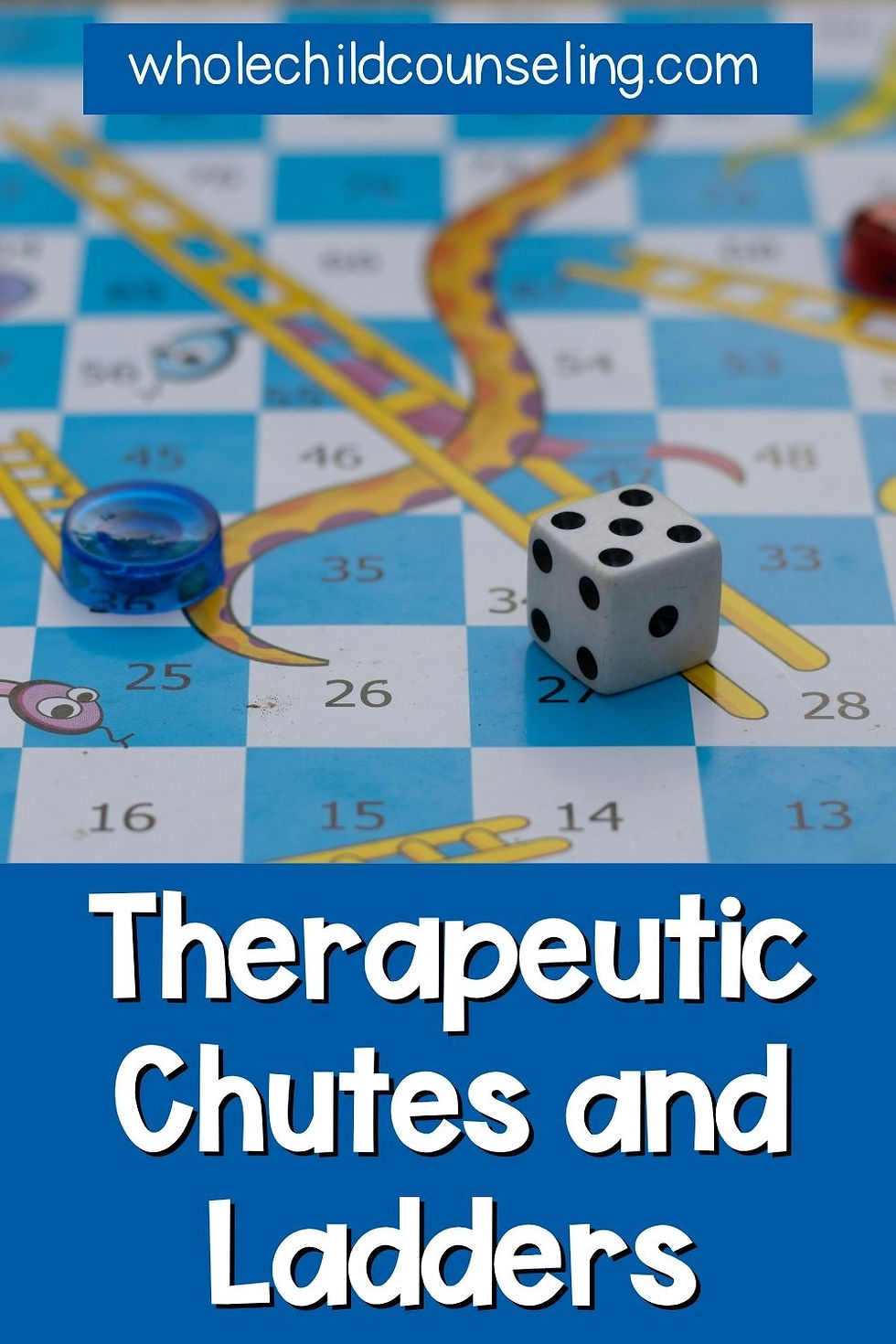
Chutes and Ladders aka Snakes and Ladders is one of the most underestimated therapeutic games for kids in any counselor's closet. Most people write it off as too simple, too young, too random. But the randomness is exactly the point. There's no skill involved in Chutes and Ladders. You can't strategize your way to winning. You draw a card and go where you go, and sometimes that means sliding all the way back down right before you reach the top. Sound familiar? It should. This game is a physical simulation of the experience that sends a lot of kids to your office in the first place: working hard at something, almost getting there, and having it fall apart anyway!
The chute (or slide) mechanic is also uniquely useful because every chute picture on the board shows a kid doing something that led to the slide. That's a built-in conversation starter you don't have to manufacture.
Chutes and Ladders Counseling Activities and Twists

Flexible Thinking: Play it backwards. Start at 100 and try to reach 1. Land on a ladder, and you go down. Land on a chute, and you go up. The thing that normally hurts you now helps you. This is one of the best cognitive flexibility exercises you can do with a board game, and kids have to hold two rule changes in their head at once without a worksheet in sight. Some kids will really struggle with this one! If they need more help with flexible thinking, check out this blog post for more activities and videos. I've also bundled my favorite flexible thinking activities for you here.
Coping Skills Review: Every time someone slides down a chute, they have to name or demonstrate one coping skill before they move their piece. If you need ideas for teaching coping skills for kids, you have to check out Skills for Big Feelings!
Problem Solving: Before you slide, look at the picture on the chute together and ask: "What was that kid feeling? What could they have done instead?" You're doing social problem-solving without it feeling like a lesson.
Gratitude: Every time you climb a ladder, name one person who has been a "ladder" in your life, someone who lifted you up or supported you. You can also check out more gratitude activities here.
Setback Script Practice: This one is especially useful for kids with rejection sensitive dysphoria or low frustration tolerance. Every time someone slides, the whole group says out loud together: "That's frustrating AND you/I can handle it." You're literally rehearsing the script they need before the next real setback hits.
Strength Sharing: Each time you climb a ladder, share one strength you've seen in someone else at the table. Watch how hard this is for some kids to both give and receive this feedback, and also how much they need it.
Flexible Thinking Version Two: Play it backwards from 100-1 AND flip what chutes and ladders do. This is a double flexibility challenge. Kids have to hold multiple rule changes in their heads at once, to work on cognitive flexibility and executive functioning.
The Question That Opens Everything: When someone hits the big chute near the top, the one that sends them almost all the way back to Start, pause and ask something like: "That's the one that gets everyone. What do you do when you're almost there and it all falls apart?"

Therapeutic Jenga
Therapeutic Jenga is awesome because the mechanics are perfect. You have to use your self-control with careful, deliberate movement. There is a tower that gets more unstable with every pull, and a collapse that's always coming, you just don't know exactly when.
Honestly, the tension in Jenga is therapeutic all by itself before you change a single rule. Watch what happens to kids' bodies as the tower gets wobblier. The held breath. The shaking hands. The freeze before the pull.
I will often model interoceptive checks ins for them and say something like: "Wow, I notice I'm getting a little nervous about this. When it's my turn, I'm holding my breath, and my shoulders feel tense. I'm going to take a deep breath to relax before I try to pull the next piece."
Therapeutic Jenga Questions and Ideas for Counseling

Write on the Blocks: Before you play, add a colored sticker dot on each block. For each different color, have feelings prompts, coping skills prompts, conversation starters, or "name a time when..." prompts. For each block you pull, you respond to what's written. Alternatively, they do also make generic versions of the game that are already colored.
Body Check-In: Before each pull, do a quick body scan. Where do you feel the tension right now? This bridges directly into somatic awareness.
Strengths Jenga: Write a character trait or strength on every block. A word like "kind" or "gentle" or "sharing" or "caring" or "funny." Pull it and read what it says. Say: "Tell the group one time you showed that trait" Great for low self-esteem, negative self-talk, and kids who struggle to see themselves clearly.
The Wobble as a Conversation: When the tower starts leaning but hasn't fallen yet, stop right there. Check in with the group: "This is the moment. What does your body feel like right now? What do you want to do? What's the smart move?"
The Fall Ritual: When the tower falls, build in a repair ritual the group decides together before you play. Everyone does a silly dance. Everyone says "we try again." Everyone takes one breath together. The fall stops being a failure and starts being a group moment.
Two Breath Rule: You have to take 2 full breaths before you touch the tower. This might help in decision quality between kids who do both breaths versus the ones who rush.
Slow Pull: You have to pull your block as slowly as possible. The act of deliberately slowing your hands down when everything in your nervous system wants to just do it and get it over with is a great regulation skill.
I feel...: For each block that is pulled, pick an emotion and put it into this sentence, I feel most [feeling word] when..." and they finish the sentence. For example: "I feel most safe when..." "I feel most anxious when..." "I feel proud when..." "I feel like nobody gets me when..." "I feel calm when..."
Nobody Causes the Fall Alone: Reframe the whole game before you start to set this up explicitly before you play. Say something like: "The tower is going to fall. That's guaranteed. The only question is what we do when it does. Falling isn't failing. What we say to ourselves and each other after the fall is what matters. So when the tower falls, it's not anyone's fault. We all contributed. We're going to practice not blaming ourselves or each other when something falls apart." Then play and debrief afterward: "How did it feel to know the fall wasn't your fault before it happened?"
Team Decision: You don't choose your own block. The group chooses together which block you pull. Everyone weighs in. Watch the dynamics: who defers immediately, who argues, who goes quiet, who takes responsibility when it falls even though it was a group decision.
Confidence Boost: Before each pull, the group tells that player one thing they believe about them. "You're steady." "You've got this." "You're more capable than you think." Then they pull. Discuss how the encouragement changes the feelings.
Hidden Sticker: Put a sticker on the middle part of a block that wont' be seen until it's pulled. When someone pulls that block, they get a "pass" they can use whenever they want.
Non-Dominant Hand: Play one full round (early in the game) where everyone pulls with their non-dominant hand. Debrief: "What did it feel like when your usual approach stopped working? What did you do?"

Therapeutic Candy Land
Candy Land is another common board game where skill means absolutely nothing. You can't think your way to winning and you can't strategize your way out of a bad draw. You just flip a card and go where you go. Honestly, I'm always surprised when my 5th graders want to play this game (especially because I also have the Dora the Explorer version but I think it feels nostalgic to them.)
For kids who spend a lot of energy trying to control outcomes, predict what's coming, or manage every variable, Candy Land is quietly challenging because it asks them to do the one thing anxiety hates most: let things go.
Candy Land Counseling Prompts
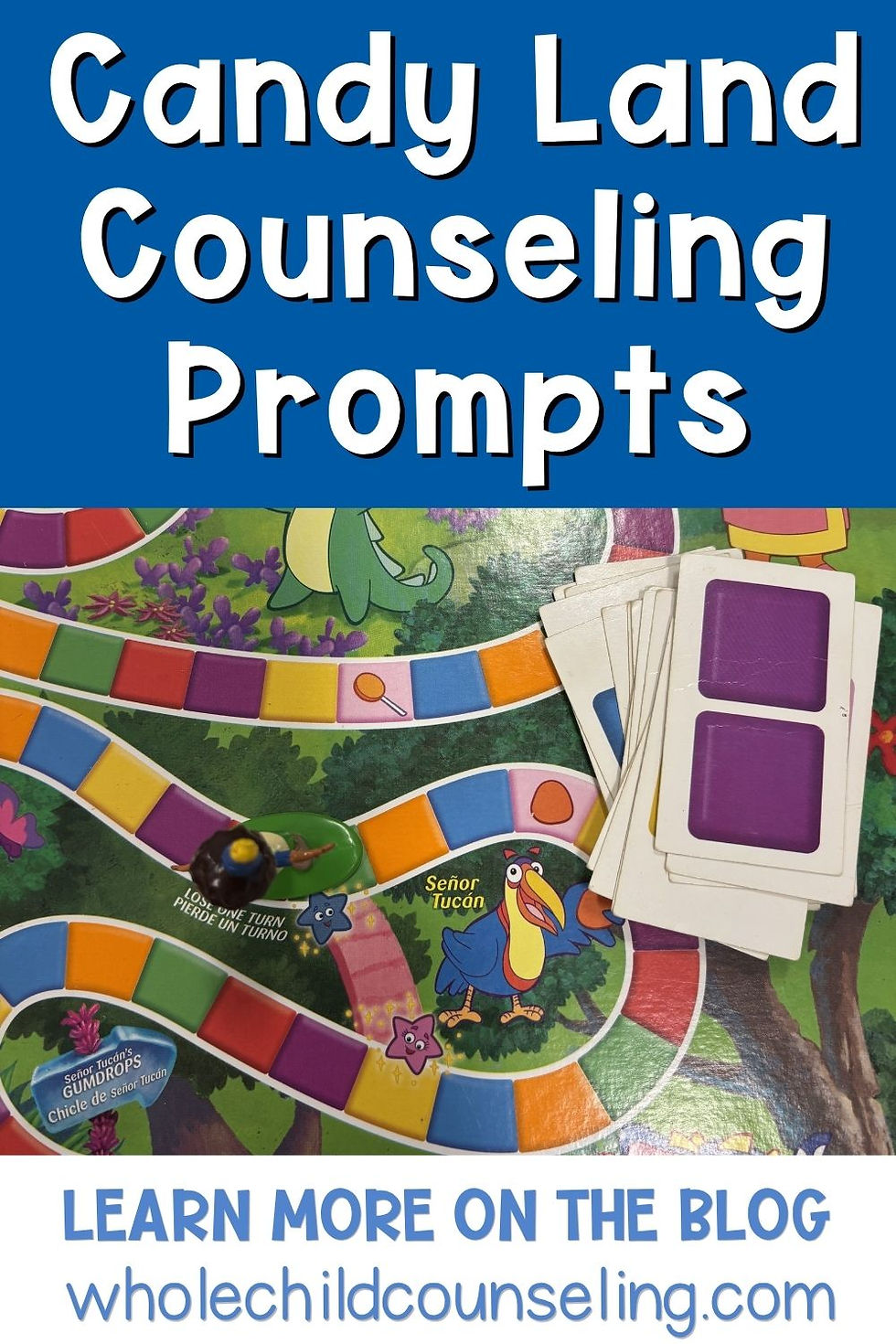
For one version of therapeutic Candy Land, you can use prompts for each of th3e special squares. You can have them answer the prompt when they get the card, or when they pass by the square.
Peppermint Forest: Share something that felt really overwhelming at first but turned out to be okay once you got through it.
Gumdrop Mountain: Share something you've worked really hard on, even if you're not at the top yet.
Molasses Swamp: Share something that's been feeling really slow or stuck lately. What's one tiny thing that might help you move even a little?
Lollipop Woods: Share something that looks fun or easy from the outside but is actually kind of hard for you on the inside.
Ice Cream Sea: Share something that genuinely made you feel good this week (not neccesarily what should make you feel good, but what actually did.)
Licorice Castle: Share something that feels a little scary or prickly on the outside but might actually be okay if you got closer to it.
Candy Land Therapy Game: Prompts and Ideas to Explore Feelings

Before you play, assign each color a feeling. Candy Land has six colors on the board, which maps beautifully onto a range of emotional experiences. Here's one way to assign them (you can do whatever makes most sense for the kids):
Red: angry, frustrated, or overwhelmed
Orange: nervous or worried
Yellow: happy, excited, or proud
Green: calm, safe, or peaceful
Blue: sad, lonely, or disappointed
Purple: confused, embarrassed, or unsure
Every time a player draws a card, they check in with the feeling assigned to that color. You don't have to use every question every turn. Pick one question per card.
Questions to explore each feeling card:
When's the last time you felt this way? What was happening?
Where do you feel this one in your body? Tight chest? Stomach? Shoulders?
What thoughts show up when you feel this way? What does your brain start telling you?
What do you usually do when this feeling shows up? Does it help?
What's one thing that makes this feeling bigger? What makes it smaller?
If this feeling had a color of its own, what would it be?
Does this feeling ever show up at school? At home? Which one more?
What's one thing someone could say or do that would help when you're feeling this way?
The beauty of this version is that kids aren't being asked to talk about their own hard feelings directly. They're talking about a color and that distance is exactly what makes it safe enough to be honest.
More Candy Land Counseling Prompts

Locus of Control: Before you start, ask: "Do you think the best player will win this game?" Let them figure out there is no best player. Then at the end ask: "What things in real life feel like Candy Land, where you work hard and it still doesn't go your way?"
Positive Self-Talk: Every time something happens that they don't like, practice saying "This is hard but I can handle this" out loud. Track how many times they say it. Discuss how naming the feeling and encouraging yourself helps change the feeling.
The Comparison Trap: Every time a kid says something where they are comparing their position to someone else's, make a tally. At the end ask: "How much of our energy went to watching other people instead of playing our own game?" You can then tie this in to a conversation about worries and comparison.
Patience and Impulse Control: Flip your card as slowly as possible and keep your face completely neutral until it's fully revealed. Then react however you want. With this simple prompt, you're building the pause between stimulus and response which is the entire goal of regulation work. Check out more impulse control activities here.
Planning and Regulation: Before you flip your card, decide how you'll celebrate if it's great and how you'll respond if it's bad. Commit to both out loud before you see the card. This way you're pre-teaching and scripting responses before the trigger, not afterward.
Interoception Prompts: Every time they go backwards, ask them to describe how their body is feeling right now. Tight? Loose? Hot? Calm? Every time a single-color card is drawn, they ask someone else a question.
End of the Game Metaphor: At the very end of the game, say something like: "This whole game, you had no control over what card you drew. But you got to choose how you reacted every single time. That's actually how a lot of life works. The cards come and what you do next is yours."

Therapeutic Don't Break the Ice
Don't Break the Ice is a game about cumulative actions and a penguin that's always at risk. My students call the penguin GG, IYKYK! 😉 Every block you tap out is one more thing the penguin's world is missing. And the fall is inevitable, the only question is when.
That mechanic is more therapeutically rich than it sounds, especially for kids working through anxiety, stress, grief, or big transitions. The ice breaking isn't a failure, it's just what happens. And the penguin always gets picked up and the ice always gets rebuilt.
I always have my kids put it back together before we put it away, so it's ready for the next group. We always talk about how satisfying it feels to click the ice blocks into place, and then we talk about other tiny joys that feel satisfying in life.
Don't Break the Ice Counseling Activities

Stress and the Cumulative Effect: Say something like: "Every block you tap out didn't break the ice alone. It was all of them together. Can you think of a time when one small thing felt like it broke everything, but really it was a lot of small things building up?" You can talk about "the straw that broke the camel's back" metaphor here.
Planning and Regulation: Before each tap, say out loud how hard you're going to tap. Gentle. Medium. Hard. Then do it. Did your tap match what you planned? What happened in your body when you wanted to go harder than you said?
Interoception Body Check-In: Before each turn, do a quick body scan. Tight shoulders? Holding breath? Clenched jaw? Notice it, then tap. After ask something like: "Did noticing your body change how you tapped?"
Slow it Down: Everyone has to tap as slowly and gently as possible. No rushing, no hard hits. This works especially well with hyperactive, impulsive, or sensory-seeking kids who want to smash things. The restraint is the intervention. Check out more impulse control activities here.
Cooperation: Everyone works together, discussing each move before anyone taps. Which block is safest? Set a goal for number of taps you can make and see if you can keep the penguin up as a team in that many taps, or less.
Planning Three Moves Ahead: You have to point to three blocks in order before you tap the first one. If the ice breaks on your planned blocks, you get an extra tap on your next turn.
Acceptance: Point to a block, then you tap it without changing your mind. After each tap say something like: "I chose that and I'm okay with it." This helps with scripting self-acceptance of decisions in real time.
Rebuilding Together: When the ice breaks, time how fast you can work together to rebuild it. Ask: "Could we go faster working alone or together? How can we plan to go fastest?"
Cooperation with Accountability: Set a goal for a certain number of taps and see if you can keep the penguin up together, but the person to your left chooses which block you tap. You have to trust them. They have to think carefully about what they're asking you to do.
Resiliency Reminder: No matter how many times the ice breaks, you always pick the penguin up and rebuild. Make that a rule and say it explicitly every single time. Say something like: "The penguin always survives. The ice always gets rebuilt."

Therapeutic Uno
Uno is one of the most naturally rich counseling games you'll ever find. The action cards alone are a clinical goldmine: skipping someone, reversing control, forcing someone to draw cards. Every one of those moments is a micro-experience of power, fairness, and relationship. There are also lots of other versions of Uno that you can find for many special interests kids have like Pokemon Uno or Lilo & Stitch Uno, etc. They also have other versions like Uno Flip or Uno No Mercy, which my kids LOVE!
Watch what happens when someone plays a Draw 4. Who apologizes? Who plays it aggressively without a second thought? Who saves it forever and never uses it? Who uses it the second they draw it? That's attachment style, conflict style, and power dynamics data without ever asking a single question.
Therapeutic Uno: Ideas for Counselors

Action Card Conversations: Name what's happening when someone plays a Skip, Reverse, or Draw 4. "How did it feel when I skipped you? How did it feel to skip me? Is there a difference?"
Observations: When someone forgets to say Uno and gets caught, watch the reaction. Shame spiral? Laugh it off? Blame others for not catching it sooner? Deny they forgot? How the tolerate mistakes in the game is likely a similar pattern of how they tolerate mistakes in their life.
Cognitive Restructuring: When someone draws a pile of cards or gets skipped, listen for the inner critic. Gently name it. "I heard you say you always get the bad cards. Is that actually true?" You might even take tallies to use as evidence. Check out more ways to use CBT with kids here.
Cooperative Play: Pair kids up and have them share a hand. Every card played has to be agreed on by both players. All the negotiation, compromise, and communication happens in real time right in front of you.
Immunity Token: Every player gets one immunity token per game (just use a small stone or aa penny, or any small object you have a few of.) You can use it to block any Draw 4 or Skip played against you, once. Watch who uses it immediately, who hoards it, and who forgets they have it. This gives you insight into patterns of self-advocacy and impulse control.
The Trading Rule: Once per game you can trade your entire hand with another player instead of playing a card. You have to ask their permission first and they can say no. That's asking for what you need, respecting a no, and adapting to a completely new situation all in one optional rule.
Creative and Flexible Thinking: Before the game, each player makes two custom wild cards with their own rule on each one. The rules they make might give you information about what they value, what they need, and what they wish they had more control over. Check out this blog post for more creative thinking and flexibility activities and videos. I've also bundled my favorite creative and flexible thinking activities for you here.
Executive Functioning: At the start of each turn, sort your hand by color and number before you choose a card. Slows everything down and help build organization habits without feeling like a lesson.
Reverse Card: When someone plays a Reverse card, everyone has to say one thing from the perspective of the person to their left before play continues. "If I were Mason right now, I'd be feeling..." This helps build theory of mind or perspective-taking skills. Check out this blog post for more perspective taking activities and videos. I've also bundled my favorite perspective taking activities for you in this growing bundle.
Draw 2 Card: When someone plays a Draw 2 card, they give two genuine compliments to the player who put the card down. This can be challening because you're making the most aggressive card into a connection moment. For ideas on "inside" genuine compliments, check out this blog post.
Wild Card: When anyone plays a Wild card, they share something random or surprising about themselves before choosing the next color. This works especially well with guarded or quiet/reserved kids.
Draw 4 Card: Instead of just drawing 4, the person who receives a Draw 4 card gets to ask any player for one card from their hand. They still draw the four, but they also get to ask for support. The most overwhelming moment in the game can become a practice moment for asking for help.
Number Check-Ins: When any one of these numbers are played, they can answer the prompt:
1 = one-word feelings check right now
2 = two things you're grateful for
3 = three breaths before your next turn
4 = four things you can see right now (grounding)
5 = five-finger breathing before you play

Therapeutic Sorry
Sorry is the only common board game where the central mechanic is a rupture and the central word is an apolog! And here's the thing: the sorry in this game isn't actually sorry at all. You say it with a smile while sending someone back to Start. But that gap between the word and the meaning is where all the therapeutic work lives.
Teach a 3-Part Apology

Before you start the game first teach a real three-part apology. It's worth doing even if you never use a single one of the twists below. For more role plays (with puppets) for teaching kids how to apologize, check out this amazing apologizing puppet role play social skills activity, you can also get it in a discount in my social skills puppets growing bundle.
Apologize and name what happened: "I’m sorry for ...” Teach them not to say the word “but” because it sounds like they're making an excuse for their behavior.
Explain that you understand the impact your action had on them: “I understand that you’re hurt because...”
Ask how you can make it right or explain how you’ll fix the situation: “Next time I will ....”
Teaching the 3-Part Apology Sorry Version:

Some of the real 3-part apology doesn't quite work for this game (like asking how you can make it right), so you can teach them this alternative version:
Name what happened: "I sent you back to Start."
Name the impact: "That probably feels really frustrating."
Name what's real: "I played the card because I'm trying to win, not because I wanted to hurt you."
Practice this 3 part apology every time a Sorry card gets played. By the end of the game, kids have rehearsed a real apology structure more times than they have in months of social skills groups, and they didn't know that was the plan!
Sorry Board Game Counseling Activities and Ideas

Before the Game: Ask: "What does it mean to say sorry?" Write their answers down. Play the game and then at the end, review the list and ask: "When we said sorry today, did it mean any of those things? What's the difference between a game sorry and a real life sorry?"
Sorry Card with Accountability: When you play a Sorry card, you have to say one genuine thing before you send someone back. Not something like "sorry not sorry." But something real like: "I know this is frustrating and I'm playing the card."
Do-Over Card: Add one custom card to the deck before you play. Whoever draws it can undo the last Sorry card played. The pawn goes back to where it was. Ask: "In real life, can we take back things we've said or done? What's the next best thing when we can't?"
Repair Card: When you play a Sorry card, you don't send someone back to Start. Instead you give them a free move of their choice anywhere on the board. Watch who plays it immediately, who hoards it, who never plays it at all.
Earn the Sorry Card: You can only play a Sorry card if you can name a time you genuinely apologized for something in real life, or if a kid gets really stuck, they can share when you accepted someone else' apology.
Self-Control Freeze: Whenever anyone gets sent back to Start, everyone freezes for five seconds. Then continue the play. You're building in a pause between rupture and reaction, which is the entire goal of regulation work. Check out more impulse control activities here.
Cognitive Restructuring: When a kid gets sent back and you hear "You hate me, you're doing it on purpose," pause and gently ask: "Is that true? Could there be another reason they played that card?" You're doing cognitive restructuring with something that just happened in front of everyone. Check out more ways to use CBT with kids here.
Scaling: "On a scale of 1 to 10, how unfair does that feel? Now on a scale of 1 to 10, how much did they do it because of you specifically?" This is a great start to a discussion. If you have kids who struggle with strong feelings about unfairness, be sure to check out this blog post on justice sensitivity.
Repair Move: After the game ends, everyone gets one repair move. You can move any pawn, yours or someone else's, one space closer to Home. Watch what happens. Watch who repairs their own, who repairs someone else's, or who doesn't repair at all.
Goal Setting: No pawn can leave Start unless you've named one real goal you have for yourself.
Protected Pawn: Each player chooses one pawn as their protected pawn at the start. I just put a piece of washi tape on it so we remember which one it is, but you can also use painter's tape that peels off easily. Nobody can send that pawn backward. Ask: "What in your real life feels like a protected pawn? What are you working hardest to keep safe?"
Cooperative Version: You can't go Home until everyone has at least one pawn past the halfway point. You can have a natural conversation about leaving people behind, slowing down for others, and what it means to really win together.
Impulse Control: Once you touch a pawn you have to move it. No changing your mind. No "wait, I meant the other one." Commit to your choice and live with it. Check out more impulse control activities here.
Drawing Reflection: After the game, each player draws their pawn's journey including every setback, every Sorry, and every close call. Ask: "Does this map remind you of anything in your real life? What's your Start? What's your Home? What are the things that feel like they keep sending you 'back' in life?"

Therapeutic Trouble
Trouble is kind of like Sorry without the apology and it has a really fun popper! You land on someone and send them back, and there's no ritual for it. No sorry, or acknowledgment.
But the Pop-O-Matic bubble is one of the most overlooked sensory regulation tools in any counselor's game closet! It produces a very satisfying pop, it requires physical engagement, and it gives kids something to do with their hands and their breath. But I always demonstrate how to pop it first, because if kids just slam their palm down, they will pop up other player's pieces, causing them frustration. So that's good impulse control practice to begin with.
Therapeutic Trouble Game Ideas for Counselors

Bubble Breathing: Before every single pop, take one breath in as you press the bubble down and breathe out as it pops back up. You've just built a breathing practice into the most fun part of the game.
Slow Pop: Press the bubble down as slowly as possible. Hold it. Then release as slowly as possible. This works especially well for kids whose nervous systems run fast and loud.
Feelings Check-In: Every time you pop the bubble, name your feeling in that moment before you look at your number. Just one word. You're building the habit of checking in with yourself before acting.
Number Check-Ins: Each time you pop one of these numbers, answer the prompt:
1: name one feeling you're carrying right now
2: name two people who make you feel safe
3: take three breaths before you move
4: name four things you can see right now
5: name one thing that's been hard this week
6: share one thing that makes you smile
Acknowledgment Rule: When you send someone's peg back, you have to say one thing before you move it. "I know that's frustrating." "That was a tough break." "You were so close, I'm sorry!"
Double X Flexibility: Normally when you land on a Double X, you get an extra turn. This time, when you land on a double X, you lose your next turn instead. The thing that usually feels great now costs you something. This helps with cognitive flexibility for kids who are very rigid.
Double X Gratitude: When you land on a Double X, name 2 things you're grateful for before you take your extra turn. You can also check out more gratitude activities here.
Double X Helper: You get the extra turn but you have to use it to move someone else's peg forward, instead of your own. Power comes with the choice to help.
Double X Banking: When you land on a Double X, you can take your extra turn now or bank it for any future turn when you really need it. Watch who uses it immediately, who hoards it, who forgets they have it, and talk to them about delayed gratification.
Double X Wildcard: When you land on a Double X, you get the extra turn OR you can give it to any other player. Watch who keeps it every single time, who gives it away, and who agonizes over the decision.
Noticing Unhelpful Thoughts: When someone gets sent back and you hear something like: "I never roll good numbers, this game is rigged!" Gently say: "There's that voice again. What's it saying? Is it actually true every time, or does it just feel that way right now?" Check out more ways to use CBT with kids here.
Protected Peg: Each player chooses one peg as their protected peg at the start (put a little washi-tape or painter's tape on it to identify it.) Nobody can send that peg backward. Ask: "What in your real life feels like a protected peg? What are you working hardest to keep safe?"
Rescue Rule: If your peg lands on someone else's peg, you don't send them back. Instead they get to move forward the same number of spaces you rolled. Landing on someone becomes the best thing that can happen to them. Watch how completely it changes the energy of the game.
Design the Repair Ritual: Before you play, the group decides together what happens every time someone gets sent back. A high five? A phrase said together? A token? The group designs the repair ritual and uses it every single time.
Rename the Game: Before you start, ask the group to rename the game based on what they think it's really about. Is it about resilience, starting over, keep moving forward, or the long way home? Whatever they choose becomes the frame for the whole session. Their name gives you some inisght into their perspective and maybe even what they're working on.

Therapeutic Connect 4
Connect 4 looks like a pure strategy game, but the therapeutic gold isn't in the strategy. It's in the interpersonal dynamics that happen around the grid. This is a 2 player game but I also have a version for multi-players called Connect More. Watch what happens when someone blocks their opponent's move instead of building toward their own win. Watch what happens when someone is about to connect four and their opponent catches it at the last second. Watch the body language, the comments under the breath, the split-second decisions.
The blocking conversation alone is worth the price of admission. When a kid uses their turn to stop you instead of advancing their own pieces, pause and name it: "You gave up your turn to stop me. When do you do that in real life? Is that usually a good strategy or does it cost you something?"
Connect 4 Counseling Ideas, Activities, and Therapeutic Twists

Flexibility and Tolerating Loss of Control: Roll a die before each turn. Odd number, play normally. Even number, your opponent chooses where you place your piece. This is one of the best interventions for kids who struggle with demand avoidance or rigidity because it's a rule, not a personal affront. If they need more help with flexible thinking, check out this blog post for more activities and videos. I've also bundled my favorite flexible thinking activities for you here.
Slow it Down: Each player has to take three slow, deep breaths before placing their piece. It sounds almost too simple. For a dysregulated or impulsive kid, it's everything.
Impulsivity: Roll a die and whatever number comes up, that's how many seconds you have to make your move. Discuss what happens when you act fast. Did speed help or hurt the decision?
Self-Control and Planning: Before you place your piece, you have to point to where you're going to play and say why. No changing your mind once you've pointed. Planning before acting, made into a rule. Check out more impulse and self control activities here.
Impulsivity and Patience: You're not allowed to place your piece for ten seconds after you've decided where it goes. Just sit with the decision. For the kids who need this most, ten seconds will feel like an eternity!
Perspective Taking Swap: Halfway through the game, swap colors. Now you're trying to win with the pieces your opponent was playing. You have to think from their perspective, use their strategy, and finish what they started.
Coping Skills Practice: Every four moves, everyone freezes and practices one coping skill together, then does a one-word feelings check-in before continuing. If you need ideas for teaching coping skills for kids, you have to check out Skills for Big Feelings, the bundle comes with short videos of the skills, which would be perfect for this!

Therapeutic Operation
Operation can sometimes produce a real physiological stress response. Every time that buzzer goes off, kids jump. Their hearts race. Their hands shake. Their breath catches. You can often see right there, in real time when the buzzer sounds, a kid's nervous system showing up and exactly what anxiety feels like in their body. The best part is you didn't have to ask them to imagine it. They just lived it! The buzzer as a nervous system lesson is so therapeutic.
I will often model interoceptive checks ins for them and say something like: "Wow, I notice I'm holding my breath, and my shoulders feel tense. I must be feeling a little nervous. I'm going to take a deep breath to relax before I try to get the piece."
Operation Game Therapy Ideas and Counseling Prompts

Before You Start: Talk about what happens in your body when the buzzer goes off unexpectedly. The jump, the racing heart, the shaking hands, the breath catching. Ask: "That thing that just happened in your body? What emotion does that feel like?" You've just introduced the nervous system, the stress response, and somatic awareness.
Building Interoception: While a kid is attempting a removal, watch their body and name what you see. "I notice your hand is shaking a little. What's happening in your body right now?" You're building interoception, the ability to notice internal physical sensations, in real time.
Buzzer Breathing: Every time the buzzer goes off, everyone pauses and takes one slow, deep breath together before play continues. The buzzer stops being a failure signal and becomes a group breathing bell.
Buzzing Without Shame: Make a rule before the game starts: every time the buzzer goes off, the whole group does something together. A silly noise. A group breath. A fist pump for trying. Whatever the group decides. The buzzer stops being something that happens TO one person and becomes something that happens WITH the whole group.
Celebrate the Buzz: Flip it completely so that every buzz gets a point. The person who buzzes the most also wins for taking the most risks. You've just reframed failure as courage. Watch who starts attempting the impossible pieces once buzzing is "worth" something.
The Anxiety Experiment: Try one piece with no pressure, no timer, no one watching. Just the kid and the tweezers. Then try the same piece while everyone watches and counts down from ten. Compare: "What was different? What happened in your body? What changed about your ability to do the exact same thing?" This is a great opportunity to discuss performance anxiety and the impact of time pressures on anxiety.
Fear of Judgment: Before you play, ask: "What's the worst thing that could happen if you buzz?" Write the fears down then play the game. Come back to the list and ask: "Did any of those things happen? What actually happened when you buzzed?" Scaling before and after is such a useful skill.
Body Mapping: Draw a simple body outline before you play and color in where you feel tension, excitement, or nervousness. Play the game then draw another body map after. What changed? Where did the feelings move? This is somatic tracking made visual and concrete, and kids find it genuinely interesting.
Holding Breath: Notice how many kids hold their breath during a tricky removal. Every time you catch someone holding their breath, name it gently: "I notice you stopped breathing. That's really common when we're nervous. Let's try that again WITH your breath." You're teaching breathwork in the most natural, real-time way possible.
Shake it Off: Between each turn, everyone does a full body shake. Arms, legs, head, everything. Shake out the tension from watching and waiting. Then the next person goes. You're teaching the body to reset between stressors, which is exactly what nervous system regulation looks like in practice.
Grip Awareness: Before each attempt, notice how tightly they're holding the tweezers. Teach them that holding too tight means tense muscles, less precision, and more buzzing. Too loose means no control. Just right means calm and engaged. "Can you find the grip that feels just right?"
Cooperative Coach: One person holds the tweezers and one person coaches, with words like: "Slow down." "Remember to breathe." "Steady." "Your shoulder looks tense." "You've got this."
Empathy Building with the Non-Dominant Hand: Do one full round where everyone uses their non-dominant hand. Everything is harder and everything feels unfamiliar. Ask: "What does it feel like to try hard at something and still struggle? What does that tell us about kids who find reading or math as hard as your non-dominant hand feels right now?" Help build empathy.

Therapeutic Labyrinth
Labyrinth by Ravensburger is a game I love to play and it's one of the most therapeutically sophisticated game on this list. Every turn, someone slides a tile into the board, which shifts an entire row or column. Your carefully planned path changes whether you want it to or not. What a metaphor for life! You can plan a perfect route to your treasure and have it destroyed in one move. You can be completely stuck and have someone accidentally open your path. And you can never go back to the way things were before the slide.
This is what anxiety, stress, grief, or big transitions can feel like for kids. The world keeps shifting and your path keeps changing. Things that were once accessible become blocked and things that felt impossible suddenly open up. And you have to keep moving anyway.
Labyrinth Board Game Therapy Ideas

Before You Start: Name what the game does. "Every turn the board shifts. Your path changes whether you want it to or not. You can't stop it. You can only figure out your next move with what you have right now." There's an anxiety and locus of control conversation starting right there before anyone even takes a turn.
Observations: Watch what happens when a kid plans a perfect path and someone else's move destroys it. Do they freeze? Explode? Adapt immediately? Shut down?
Treasure Order: You have to collect treasures in a specific order. You can see other treasures. You might even be able to reach other treasures. But you can only collect yours in sequence. "What does it feel like to see something you want and not be able to go for it yet? When do we have to do things in order even when we don't want to?"
Plans vs. Reality: Before your turn, describe your plan out loud. Then describe what actually happened. Over the whole game, track how often the plan matched reality. "What does that tell us about planning? Is planning useless, or is it still worth doing even when things change?
Flexibility Bonus Points:
Changing your plan mid-turn when you realize it won't work = 2 points
Helping another player accidentally and naming it with good humor = 2 points
Adapting within ten seconds of your path being destroyed = 2 points
The Rigid Experiment: One round where you commit to your plan no matter what. Even if the board shifts and your path is gone, keep trying to execute the original plan. Then debrief: "What happened when you refused to change your plan? When do we do that in real life? What does it cost us?"
Three Path Rule: Before each turn, identify three possible paths to your treasure, not just one. Then choose the best one. Ask: "What's your backup plan? What's your backup backup plan?"
Locus of Control: Before each turn, identify what you can and can't control. You can control which tile you slide and where you move your piece. You can't control what other players do or which tile gets pushed out. Separating what's in your control from what isn't, every single turn, for the whole game.
Reframing the Block: When someone slides a tile that blocks your path, watch for the reaction. "They did that on purpose." "They always block me." Gently pause: "Do you know for sure they were trying to block you? Could they have been just trying to help themselves?"
The Debrief: At the end of the game, ask each player how many times they thought someone was blocking them on purpose. Then ask the blockers how many times they were actually trying to block that specific person. The gap between those numbers is almost always significant. That's your cognitive distortion conversation with real-time evidence. Check out more ways to use CBT with kids here.
Breathe Before Sliding: One breath before every tile slide. You're practicing making intentional moves in an uncertain world.
Naming Treasures: Before you play, rename the treasure cards with things kids are actually working toward. Maybe it's a goal, a feeling they want more of, or a skill they're building. Now the whole game is a metaphor for their journey.
Asking for Help: If a player has been stuck on the same treasure for three turns, they can ask for a two-minute strategy session where everyone else can offer suggestions. They don't have to take any suggestion, but they have to listen to all of them. Asking for and receiving help is a great life skill to reinforce.

Cooperative Version: Pairs share a pawn and a treasure card. Every tile slide and every move has to be agreed on by both players. All the negotiation, compromise, and communication happens in real time right in front of you.
Loss and Transitions: Use this metaphor with kids navigating loss or big changes. "Your treasure is still there. No matter how many times the board shifts, the treasure on your card doesn't change. Your path to it just keeps changing. Even when everything around you shifts, what you're moving toward doesn't disappear."
Drawing Reflection: After the game, kids draw their pawn's journey. Every blocked path, unexpected opening, and treasure found. Ask: "Does this map remind you of anything in your life right now? What's been blocking your path lately? What unexpected openings have you found?"
You don't need to use every twist in this post! Just pick one or two that fit your specific kid, your specific goal, and your specific session. Less is more.


